
Why I Turned Quotes Into a Real Income Stream (And You Can Too)
Here’s something nobody tells you: those little quote graphics you see scrolling past on Facebook and Pinterest? People are quietly making real money from them.
I know, because I’m one of them.
When I first started, I thought quotes were just pretty pictures — something you share, not something you sell. Then I started paying attention. The accounts posting daily quotes were growing fast. They were building email lists. They were selling quote packs, prompt vaults, and print-on-demand products with those same words slapped on mugs and journals and wall art. The humble quote was doing a lot of heavy lifting.
And the best part? This is work that rewards being over 40, not the other way around.
Think about it. A good quote isn’t about fancy design or being the loudest voice in the room. It’s about knowing what people are actually feeling — and saying it in a way that stops them mid-scroll. That takes life experience. You’ve lived enough to know what lands. You know the difference between a line that sounds nice and a line that hits someone right in the chest. That’s not something a twenty-two-year-old can fake.
So here’s how quotes can actually make money, in plain terms:
They grow an audience. People follow and share quote accounts more than almost anything else. That’s free reach.
They build your email list. Offer a free pack of quotes or a quote-prompt vault, and people happily hand over their email to get it.
They sell as products. Quote packs, prompt bundles, printables, and print-on-demand items (mugs, journals, tote bags, wall prints) all sell — and once you make them, you can sell them again and again.
They feed everything else. A single strong quote can become a Pinterest pin, a Reel, a caption, a product, and a lead magnet. One idea, many uses.
You don’t need to be a designer. You don’t need a big following. You need to know what to say — and honey, at our age, we’ve earned that.
If this is the kind of thing you’ve been curious about but didn’t know where to start, come join us. This is exactly the stuff we dig into together.
One tool that makes this easy:
The quotes I use? I make them with a tool called the Quote Edit Bot, and honestly, it’s the thing that took this from “nice idea” to “something I actually do.” You can get any kind of quote you want out of it — any mood, any style — without fighting with design software. It’s the same tool I use every day, and you can grab it here.
→ Join the free Digital Business After 40 community — where we turn everything we’ve learned into something that actually pays.
The Best Quotes Aren’t Clever. They’re True.
Here’s a mistake I see people make all the time with quotes.
They try to be clever. Fancy words. A twist. Something that sounds smart.
And it falls flat.
The quotes that actually stop people mid-scroll aren’t the clever ones. They’re the true ones. The line that makes someone go “oh, that’s exactly how I feel, I just never said it out loud.” That’s the whole game. You’re not trying to impress people. You’re trying to name something they’ve been carrying.
That’s why our age is such an advantage here.
You’ve lived enough to know what people actually feel. You’ve sat with your own hard seasons. You’ve watched friends go through theirs. You know the difference between a line that’s just pretty and a line that lands like a hand on the shoulder. A twenty-year-old can copy a quote. They can’t fake having lived one.
So here’s how I pick a quote worth posting. I ask myself one question: would this have helped me on a hard day?
Not “is this smart.” Not “will this go viral.” Just, would this have met me where I was.
If the answer is yes, it’s worth posting. If I’m reaching for clever, I stop and start over.
Try it with your next one. Write the truest thing you know about whatever you’re posting on. Say it plain. Don’t dress it up.
That’s the quote people save. That’s the quote people share. And you already have a lifetime of them in you.
One tool that makes this easy is the Quote Edit Bot. It’s what I use to make my own quotes, and it’ll give you any kind of quote you want, any mood, any style, without fighting with design software. If you want to try it, you can grab it here.

Stop Guessing With Pinterest and Your Blog. I Built You a Home Base.
For a while, I had my blog stats in one notebook, my Pinterest ideas in another app, and my actual to-do list living in my head at 11pm. Nothing was lost exactly. It just wasn’t anywhere I could find it.
If that sounds familiar, here’s the thing nobody tells you when you start a blog after 40. It’s not the writing that wears you down. It’s the scatter. Ten tabs open. Three half-finished planners. A setup checklist you started once and can’t find again.
You don’t need more tools. You need one place that holds what you already have.
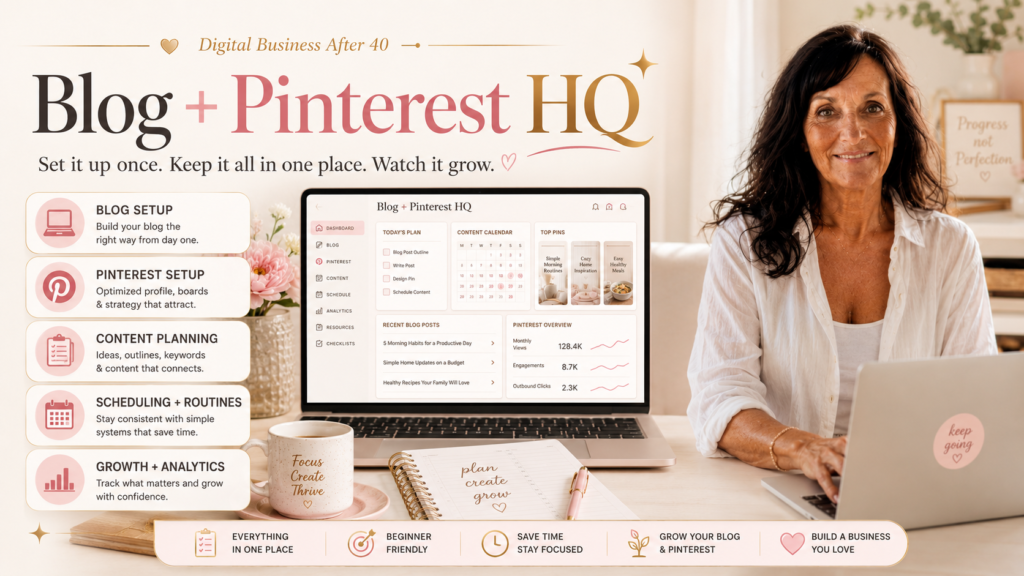
That’s exactly why I built Blog + Pinterest HQ. It’s one spot to track your setup, log your monthly numbers, and write down what’s actually working, so you stop carrying it all around in your head. You open it, you see where you left off, you do the next thing. That’s it.
Here’s what usually stops people before they even try something like this.
“I’m not techy enough to keep something like this updated.” You don’t need to be. You type into a box and it saves. That’s the whole skill required.
“I’ve started organizing systems before and abandoned them.” Most systems fail because they ask too much of you. This one only asks for what you’d be tracking in your head anyway, just written down somewhere you can see it.
“I don’t have anything worth tracking yet.” That’s exactly when to start. Small numbers now become proof of growth later. You can’t see your progress if you never wrote down where you began.
I built this because I was the person drowning in tabs. I’m not handing you a system I found online. I’m handing you the one I actually use.
Your next step: Blog + Pinterest HQ is waiting for you inside the free Digital Business After 40 community. Come get organized.
You Don’t Need to Learn to Code. You Need to Learn to Ask.
Somewhere along the way, “AI” started sounding like something for twenty-five-year-olds in hoodies. Like you needed to already understand computers to be allowed to use it.
That’s not true, and it’s kept a lot of people over 40 sitting on the sidelines of something that was actually built for them.
Here’s what AI tools like Claude actually are. Not a genius. Not a shortcut around thinking. A conversation partner that does the typing and the staring at a blank page for you, while you bring the thing it can’t fake: your actual life experience.
I build my entire business on an iPad and a laptop. No coding background. No tech degree. What I have is thirty-plus years of knowing how people talk, what problems are real, and what a bad sales pitch sounds like from a mile away. That’s the part AI can’t do. That’s the part you already have.
Three things usually stop people from trying.
“I don’t know the right way to talk to it.” There isn’t one right way. You describe what you want in plain English, the same way you’d explain it to a friend. It asks you questions back if it needs more.
“I’ll say something wrong and it’ll give me garbage.” So you try again. That’s the whole process. Nobody gets it perfect on the first try, including me, still.
“It’s going to replace what makes me, me.” It can’t. It doesn’t know your voice, your stories, or your read on people. You feed it those things. It hands you back a draft. You’re still the one steering.
I didn’t wait until I felt ready or qualified. I opened it and started asking questions, the same way you’d ask a smart friend to help you think something through.
Your next step: If you want to see exactly how I use tools like Claude to build without knowing how to code, come find me inside Amplifi-AI Your Business.
The Third Thing I Learned From Quotes (And Why I Almost Quit)
I’ve already told you why I started making quote content, and why I believe the best ones aren’t clever, they’re true. Here’s the part I left out. I almost quit before any of it worked.
The belief that stopped me was simple: quotes are too small to matter. Anyone can post a quote. Where’s the actual value in that.
Here’s what I know now that I didn’t know then. Small, honest content is what earns trust before anyone buys anything from you. A quote that makes someone stop scrolling and think “yeah, that’s exactly it” does more for you than a polished sales page nobody reads to the end.
What changed once I stuck with it: people started saving my posts. Not liking them and moving on, saving them. That’s a different kind of connection. Someone doesn’t save something they’re going to forget.
Here’s what almost talked me out of it, in case it’s talking you out of it too.
“It’s not a real business, it’s just quotes.” It’s not the quotes. It’s the consistency and the honesty behind them. That’s the actual product.
“Everyone’s already doing this, why would mine stand out.” Because nobody else has your read on what’s true. The words might be shared, your timing and your reason for choosing them isn’t.
“I don’t have the design skills to make these look good.” I don’t either. I use the Quote Edit Bot to do the design work, so I can stay focused on picking words that land instead of fighting with software.
I almost walked away from the simplest thing I do, because I decided it didn’t count as real work. I was wrong. Don’t make my mistake.
Your next step: if you want the same tool I use to turn quotes into something real, you can grab it here.

How to Actually Get Seen Inside Skool (Without Feeling Salesy)
If you’ve started a community on Skool, you’ve probably had this thought: I built it, why isn’t anyone finding it.
The belief that trips people up here is that visibility means running paid ads, and if you’re not doing that, you’re doing it wrong.
Paid discovery is one option Skool offers, but it’s not the main lever, and it’s not where most growth actually comes from. Real visibility inside Skool comes from three things working together: your own consistency, your existing members talking about it, and showing up in the free spaces where your people already hang out.
Here’s what that looks like in practice. Post inside your own community often enough that it feels alive when someone new walks in. Ask your current members to invite one person, one time, instead of hoping they’ll promote you unprompted. Show up as a real person in other free communities and Facebook groups where your audience already spends time, not to pitch, just to be useful and visible.
Three things get in the way of people trying this.
“I don’t want to seem like I’m always selling.” You’re not selling when you’re being useful somewhere your people already are. You’re just visible. That’s different.
“My community is too new to invite anyone.” New is when momentum matters most. An empty room stays empty. A few real conversations early on are what make it feel worth joining.
“I don’t know what to say when I show up in other groups.” Say what’s true. Share something you learned, answer a question honestly, mention what you’re building only when it’s relevant. People notice the person who’s actually helpful.
I didn’t grow my community by running ads. I grew it by showing up consistently and being honest about what I was building, even when almost no one was watching yet.
Your next step: come see what a community built this way actually looks like. Join Digital Business After 40 free.

Proudly powered by WordPress