Email that gets opened
How Do You Start an Email List After 40 When You Have Nobody to Send To?
How to start an email list after 40 when nobody is on it yet: the one tool I use, what to send first, and where your first 20 subscribers come from.
 By Tina Alexander
Everybody says “build your list.”
And if you’re over 40 and starting from zero, that advice can land like a slammed door. Build it from what? You have no subscribers. Maybe a few hundred followers who never comment. And a quiet voice saying you should have done this ten years ago.
Here’s the honest answer to the question in the title. You start an email list after 40 by picking one free email tool, offering one small useful thing in exchange for an email address, and inviting the people who already know you first. Then you write to them like a person, once a week. That’s it. No ads. No funnel diagram. No waiting until you’re “ready.”
And here’s the part nobody told you. You already know how to do this. You’ve spent decades keeping in touch with people. Following up. Remembering who needed what. Sending the note, making the call, checking in. That’s the whole skill behind an email list. You’ve just never been told it counts.
You are not too old. You are not too late.
Key Takeaways
- An email list is the one audience you own. No algorithm decides who sees your message.
- You can start with zero subscribers, a free tool, and one simple freebie.
- Your first subscribers come from people who already know you, not strangers.
- Write every email to one person, the way you’d write to a friend.
- One email a week, sent every week, beats a perfect launch you never send.
Why Does an Email List Beat Followers After 40?
I posted on social media on and off for about two years. Not much happened. A like here, a kind comment there, and a lot of shouting into a room that was mostly empty.
It wasn’t because my posts were terrible. It’s because social platforms decide who sees what you post, and most of your followers never do. Socialinsider’s 2026 data puts the average Facebook post’s organic reach at about 1.8% of a page’s followers. Read that again. Out of every 100 people who chose to follow you, fewer than two might see a given post.
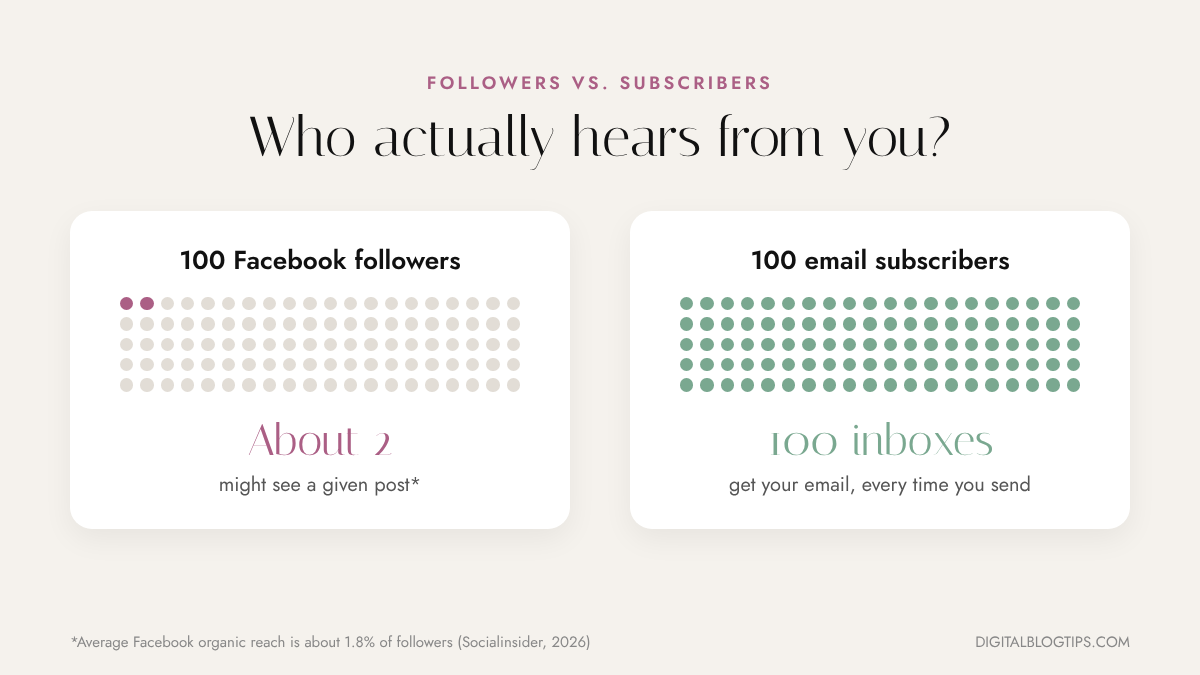
Email works differently. When someone joins your list, your message goes to their inbox. Not to a feed that might show it. To the place they check every day.
People like it that way, too. A survey from Woo and Klaviyo, reported by eMarketer, found that 59% of adults worldwide say email is their preferred way to get offers and updates from brands. And small business owners agree. In a 2025 Constant Contact survey, 44% of small businesses named email as their most effective marketing channel.
Here’s why this matters more for us than for a 22-year-old influencer. We’re not trying to go viral. We’re trying to build trust with real people who need what we know. That happens in conversation, over time. Email is a conversation. A feed is a billboard.
What Do You Need Before You Pick an Email Tool?
Most people start with the tool. They spend a week comparing software, watching tutorials, and building a welcome sequence for subscribers who don’t exist yet. Then they’re tired and nothing has gone out.
Start with two answers instead.
Who are you writing to? Not “everyone over 40.” One person. What’s keeping them up at night? What have they already tried? When I picture my reader, I see someone who’s smart, capable, and has run a household or a team or a career, and who quietly suspects the internet passed them by. Every email I write is to that person.
What will you hand them? People trade their email address for something useful. So decide what your useful thing is before you build anything. It doesn’t have to be big. We’ll get to that in a minute.
If you’re not sure who you’re for yet, or you feel buried before you’ve even started, read this first. The Late Starters Advantage is my free guide for people over 40 who feel overwhelmed by the whole “put yourself out there” part. It walks you through first impressions, naming your brand, and what to post for 30 days, with copy-and-paste AI prompts so you’re never staring at a blank page. Grab it before you build anything else.
And if you don’t have a place to sell or deliver things yet, my guide on how to set up an online storefront covers that step in plain English.
How Do You Pick an Email Tool You Won’t Abandon?
Here’s my rule. The best email tool is the one you’ll actually open.
You need two things to start:
- A way for people to sign up. A simple form or page where someone types their email and gets your freebie.
- A way to send them a message. A plain email, typed and sent.
That’s it. Automations, tags, segments, fancy templates. All of that can wait. You can add it later, once there’s someone on the list to send to.
I use Beacons. My store, my freebies and my email all live in one place, and I send every broadcast from there. When someone buys one of my products, an after-purchase email goes out to them automatically, and I didn’t have to build anything complicated to make that happen. For me, having everything in one spot is the difference between showing up and giving up.
I’m only telling you what I use because I only recommend what I’ve actually used. Whatever you pick, look for a free or low-cost starting plan and those two features. If the setup makes you want to close the laptop, that’s your answer. Pick something simpler. If you want to see the rest of what I use, here are the online business tools after 40 I’d actually keep.
Can Your First Freebie Really Be One Page?
Yes. And it probably should be.
A freebie (some people call it a lead magnet) is the small, useful thing someone gets when they join your list. The mistake I see over and over is people trying to build a 40-page ebook before they’ve got a single subscriber. It takes months. And it often doesn’t get finished.
Ask yourself one question: what’s the smallest useful thing someone would happily trade an email for?
That could be:
- A one-page checklist for a task your reader dreads
- Five prompts they can copy and paste into ChatGPT or Claude
- A short “start here” guide that answers the question you get asked most
Here’s something I learned the slow way. For a long time I made PDFs. Signups barely moved. It wasn’t until I had my own community and switched from PDFs to simple interactive apps, where people could click and use the thing right away, that sales and email signups started coming in. Your reader wants a quick win, not homework. I wrote up the whole switch in should your lead magnet be a PDF or an app.
The freebie isn’t the business. It’s the handshake.
Where Do Your First 20 Subscribers Actually Come From?
Not strangers. Not ads. People who already know you.
This is where your age is a real advantage. You’ve built decades of relationships. Old coworkers. Friends from church or the gym or the school pickup line, years ago. People in the Facebook groups you’ve been part of forever. These people already trust you. They’re the warmest audience you’ll ever have.
Here’s where to look:
Your own contacts. Send a personal note to people you think would find your freebie useful. Not a blast. A real message. “I made this for people in our stage of life who are trying to figure out AI. Thought of you.” Some will join. Some will tell a friend.
Communities you’re already in. Being active in online communities, and later starting my own, did more for my reach than two years of posting into the void. Show up, help people, and when it fits the group’s rules, share your freebie.
Your own small room. A free community gives people a place to gather around you, and that room naturally feeds your list. My guide on how to start a free Skool community shows you how I set mine up.
Your own corner of Google. A blog keeps working when you’re not posting. Someone searches a question you’ve already answered, finds your article, and grabs your freebie at the bottom. Here’s how to start a blog after 40 if you want that working for you too.
I’ll be honest with you. Growing my email list took longer than my other channels. It moved slowly for a while before it finally started growing. Slow isn’t failure. Slow is how trust gets built.
What Should You Send So Your Emails Get Opened?
Write to one person.
Not “Hello everyone!” Not “Dear valued subscribers.” Picture the one reader you described earlier, and write to them like you’re explaining something to a friend over coffee. Short sentences. Plain words. A little bit of you.
Here’s a trap I see all the time. Someone gets a handful of subscribers and then sends nothing, because they’re waiting until they have something “worth saying.” The longer the gap, the harder that first email gets. Don’t wait. The people on your list joined because of you. They don’t need a masterpiece. They need to hear from you. And if you’ve already gone quiet for months, here’s what to send when you haven’t emailed your list in a while.
A few things that help:
- The subject line is a door, not a headline. Its only job is to get opened. Write it like a text to a friend: “the mistake I made with AI” beats “Monthly Newsletter Issue 3.”
- Give one thing per email. One tip, one story, one prompt. If you have three ideas, that’s three weeks of emails.
- Tell real stories. The first time I tried AI, I typed one vague line, got generic mush back, closed the laptop and thought, “this isn’t for me.” That one story does more than ten tips, because your reader has been there too.
- Make it worth staying for. According to GetApp research cited by eMarketer, 40% of US consumers unsubscribe from brand emails or texts every week. People leave lists that only sell or only fill space. Be useful and be yourself.
If your emails seem to disappear after you hit send, they may be landing in the wrong place. My guide on why your emails go to spam walks you through the fixes in plain English.
Not sure what to send first? I wrote out the whole starting stretch for you in Your First Seven Emails, so you’re never staring at a blank screen wondering what to say.
What Rhythm Keeps an Email List Alive?
One email a week. Same day, if you can manage it.
That’s the whole rhythm. Not a 12-part launch sequence. Not a daily newsletter you’ll burn out on by March. One honest email, every week, that helps your reader with one thing.
Why does consistency beat perfection? Because people forget. If they join your list in January and hear from you in May, they won’t remember who you are. If they hear from you every Tuesday, you become someone they know.
You’ve done this kind of thing your whole life. The birthday cards. The check-in calls. Showing up when you said you would. An email list is the same muscle, pointed at your business.
7 Practical Steps to Start Your Email List This Week
- Name your one reader. Write two sentences about who they are and what they’re stuck on. Keep it where you can see it.
- Pick your freebie. Choose the smallest useful thing you could make in a day: a checklist, five prompts, or a one-page guide.
- Choose one email tool. Look for a free or low-cost plan with a signup form and the ability to send a broadcast. Set up only those two things.
- Make your signup page. One headline, one sentence about what they get, one email box. Done.
- Invite 20 people you already know. Send personal messages, one at a time. Tell them why you thought of them.
- Write your first email before anyone joins. A short hello: who you are, why you started, and what they can expect from you. Then it’s ready the moment your first subscriber arrives.
- Pick your sending day. Put it on your calendar like an appointment. Then keep showing up.
Frequently Asked Questions
How many subscribers do I need before I start sending emails? One. If one person joined your list, send them an email. Waiting until you have “enough” people is how lists go cold. Writing to a small list is also the best practice you’ll ever get, because you can learn what lands before more people are reading.
Is it too late to start an email list after 40? No. Email rewards trust and consistency, not youth or trends. People over 40 often have decades of relationships, real-life experience, and a habit of following up, which are exactly the skills that make an email list work. Your age gives you more to say, not less.
Do I need a website to start an email list? No. Many email and storefront tools give you a simple signup page you can share with a link. You can post that link in your social bio, in communities, or in a personal message. A website can come later. Your first job is giving people a way to join.
What if I have nothing to say in my emails? You have more than you think. Share one thing you learned this week, one mistake you made, one tool you tried, or one question your reader keeps asking. Your real experience is the content. Readers don’t want polished lectures. They want an honest voice from someone a step ahead.
How often should a beginner send emails? Once a week is a strong, sustainable rhythm for beginners. It’s often enough that people remember you and rare enough that you won’t burn out. Pick a day, put it on your calendar, and keep it. Consistency builds trust faster than any single brilliant email.
You Already Know How to Do This
Go back to that slammed-door feeling. “Build your list.” From what?
From the same thing you’ve always built with. Relationships. Following up. Showing up for people when you said you would. You’ve kept families running, teams going, friendships alive across decades and miles. Nobody had to teach you to stay in touch. You just did it.
An email list is that, with a signup form.
So pick your one reader. Make your one small useful thing. Invite the people who already know you. Write the first email before you feel ready, and send the next one a week later.
You don’t need a big audience to start. You need one person who wants to hear from you, and the nerve to hit send.
Your age isn’t the reason you’re behind. It’s the reason people will listen.
Come build alongside us. The list I write to started as a room like this one. Join the free Digital Business After 40 community, a supportive place for people over 40 who are building real things online, one clear move at a time.