Building a free community
Why Is Nobody Posting in Your Free Community (And How to Get Them Talking)
Is your free community too quiet? Here is how to get members to engage, one real conversation at a time, and why starting later makes you a better host.
 By Tina Alexander
You did the hard part. You opened your community. People actually joined.
So you wrote a post. A good one. You asked a thoughtful question and waited.
Nothing.
You checked again after lunch. Still nothing. Then the little voice shows up: maybe they don’t like me. Maybe this was a mistake.
I want you to hear this first. A quiet community is not a verdict on you. It’s what week one looks like for almost everyone. And the fix is smaller than you think.
Key takeaways
- Most new members read before they ever post. That’s normal, not rejection.
- Big, deep questions freeze people. Small ones get answers.
- Ask things people can answer in ten seconds: this or that, one word, finish the sentence.
- Reply to every single post like a host, by name, with one follow-up.
- Three people answering is a good week. Build on those three.
Why is nobody posting in your community?
Because most people are lurkers first. They join, they look around, and they wait to see if it’s safe to speak up.
Think about walking into a party where you don’t know anyone. You don’t grab the microphone. You find the snack table and watch for a while.
Your members are doing the same thing. They’re reading. They’re deciding if this is a room where they’ll be judged or a room where they’ll be welcomed.
For people over 40, that hesitation runs deeper. A lot of us feel behind with tech. We worry we’ll ask a “dumb” question in front of strangers. So we stay quiet until someone shows us it’s okay not to.
If you’ve read my guide on how to build an online community after 40, you know my own community grew slowly, one conversation at a time. I honestly don’t remember the exact day someone other than me posted first. What I remember is that it took longer than I wanted, and that the quiet part didn’t last forever.
Your job right now isn’t to get everyone talking. It’s to make it easy for one person to go first.
Your first fix: you’re asking for too much
Here’s the mistake I see most often. The welcome post says something like:
“Tell us about yourself, your goals, and what you hope to get out of this community!”
That sounds friendly. But read it as a nervous new member. That’s three questions, and they all need a paragraph. Goals? Out loud? In front of strangers?
So they close the tab and tell themselves they’ll come back when they have time to write something good. They don’t come back.
Big questions freeze people. Small questions get answers.
Questions people can answer in ten seconds
The best early questions take almost no effort and have no wrong answer. Here are three kinds that work.
This or that. “Morning person or night owl?” “Do you build on a phone or a computer?” “Pen and paper or notes app?”
One word. “One word for how you feel about AI right now.” “What’s one tool you actually use every day?”
Finish the sentence. “The thing I’m most curious to learn this month is…” “I joined because…”
Notice what these have in common. Nobody has to share their whole life story. Nobody can get them wrong. And every answer gives you something to reply to.
Once people answer small things, they start answering bigger things on their own. That’s how trust builds. One easy yes at a time.
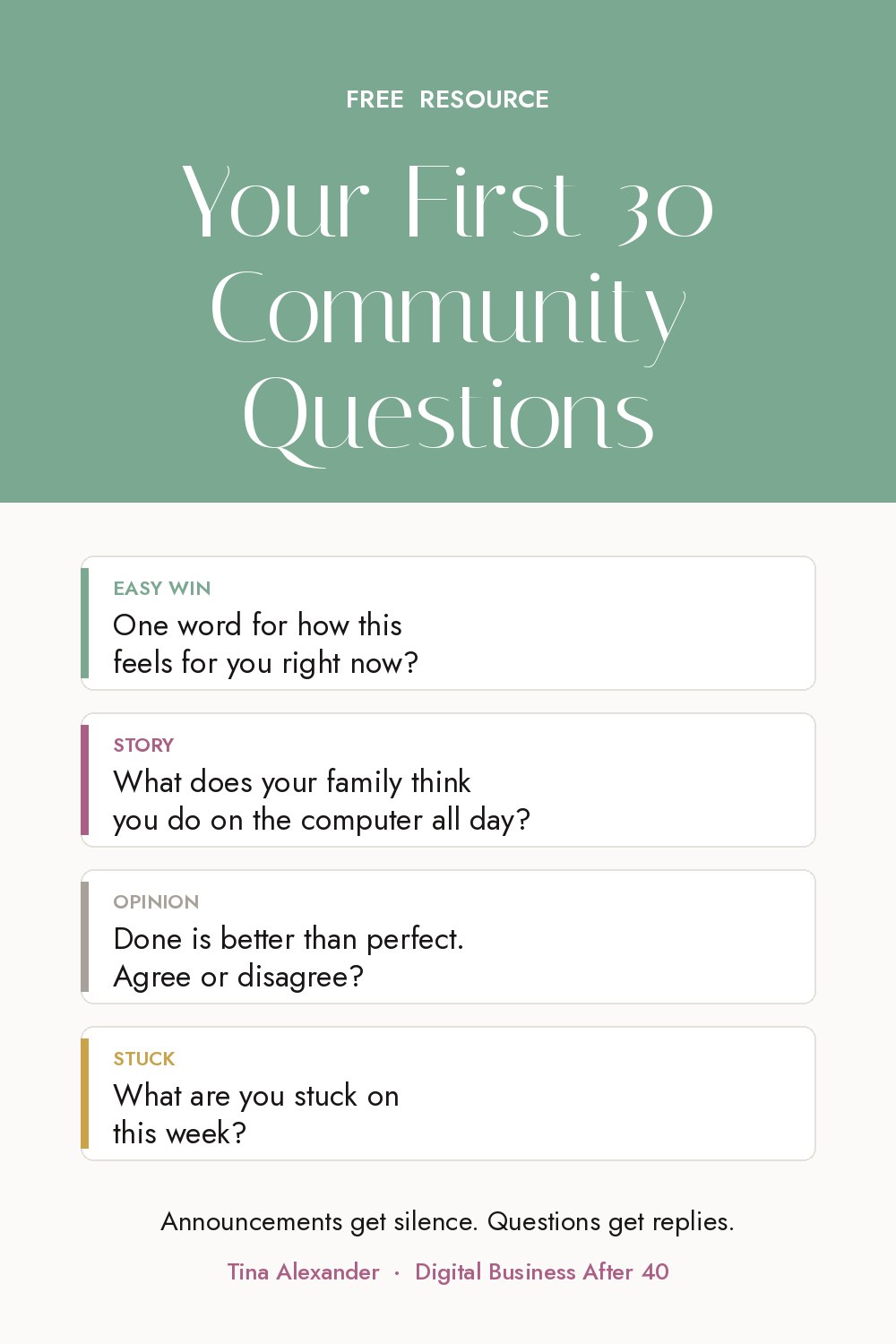
If you’d like a ready-made list, I put together Your First 30 Community Questions. It’s free, and you can copy one a day for a month.
Reply like a host, not a manager
This part matters more than the question itself.
When someone answers, they’re taking a small risk. What happens next decides if they ever post again.
So reply to every single one. Use their name. Add one follow-up question.
Not this: “Thanks for sharing!”
This: “Linda, a night owl like me! What do you usually work on after dinner?”
That second reply tells Linda three things. You read it. You care. And there’s a real person on the other side.
A few simple rules I follow:
- No post left alone. Every post gets a reply from you, even a short one.
- Use names. People light up when they’re seen.
- One follow-up, not five. Keep it light so it’s easy to answer.
- Tag people into conversations. “Ann, you mentioned Canva last week. Any tips for Linda?” Now two members are talking, and you didn’t have to carry it.
You know how to do this already. You’ve probably spent decades making people feel welcome at work, at family dinners, around the kitchen table. Same skill. New room.
The quiet welcome message that turns a reader into a poster
When someone new joins, send them a short, warm welcome. No pitch. No link to buy something. No list of rules.
Something like:
“Hi Debra, so glad you’re here. No pressure to post anything big. Just curious, what made you click join today?”
That’s it. One easy question they can answer in a sentence.
Some people will reply privately first. That’s fine. Thank them, and then gently ask: “Would you be okay if I shared that in the main feed? I think others would relate.” A lot of first posts start this way.
What a good week looks like when only three people answer
Let’s be real about this. You might post a question and get three answers. Maybe two.
That’s a good week.
Three people talking is a conversation. Reply to all three. Ask each a follow-up. Mention them by name in your next post: “Loved what Carol said yesterday about learning on her lunch break.”
Now Carol feels seen. And everyone reading sees that people who post here get noticed.
Here’s a simple rhythm for a quiet community:
- Monday: one ten-second question.
- Every day: reply to anything new, by name.
- Midweek: share one small win or lesson of your own.
- Friday: a check-in. “What’s one thing you got done this week, big or small?”
Four touches. Not forty. You’re building a habit for your members, and a habit needs a steady, gentle rhythm.
When silence is fine and when it’s a real problem
Silence is fine when:
- You’re in your first few weeks.
- People are joining but reading quietly.
- One or two people reply most weeks.
That’s a community warming up.
Silence is a real problem when:
- Weeks go by and nobody replies to anything, even tiny questions.
- People join and leave quickly.
- You’ve stopped posting because it feels pointless.
If that’s you, look at two things. First, who is the room for? A small, specific room (“AI for beginners over 40”) is easier to join and talk in than a big, vague one. Second, where are your members coming from? If they’re random people who don’t really want what you’re teaching, they won’t talk. My guide on getting your first community members walks through finding the right people.
And if you’ve stopped posting, start again with one ten-second question. That’s all. You don’t need a comeback plan.
Questions people ask about this
How long does it take for members to start posting?
There’s no honest single answer, and I won’t pretend there is. It depends on how often you show up and how easy you make it. What I have seen is that small questions and real replies help every time.
Should I post every day?
Not at first. A few steady posts a week, plus replying to everything, beats a daily post nobody answers. Consistency matters more than volume.
Is it okay to answer my own questions?
Yes. Go first. Share your own answer so people see how short and simple it can be.
What if the same two people answer everything?
Be grateful for them. They’re your early regulars. Thank them, and use their answers to pull others in by name.
You’re a better host than you think
A quiet room doesn’t mean you failed. It means people are deciding if they’re safe with you.
You’ve spent a lifetime learning how to make people feel welcome. Ask small. Reply by name. Keep showing up. That’s how a quiet room turns into a real community, one conversation at a time.
And if you’d like to see what that looks like, come join us in Digital Business After 40. It’s free, it’s full of people building later in life, and someone will say hi the minute you walk in.